When people buy or inherit an older apartment, the first plan is often to strip everything out and start again. It feels clean, but it is usually the most expensive option, and it throws away the things that make an older home feel different from a new one: solid doors, good tiles, real timber, the proportions of the rooms.
A better first question is not "what should we buy?" but "what is worth keeping?"
An architect's home built from its own salvage
In New York, architect Diana Kellogg has lived in the same Tribeca building for 25 years. It began as cold storage, became a plumber's shop and was turned into a home about 50 years ago. When her children moved out, she renovated it again, and much of the new work came from the building itself.
An old freight elevator was removed, and its salvage, along with other parts of the building, was used to make the kitchen, bookcases and a staircase connecting the four floors. "Throughout the house there were old glass and steel doors, and windows and stuff," Kellogg told Dezeen. "I just moved them around and repurposed them."
She also stripped the 25-foot chestnut beams on the ceiling. "It was a massive pain in the neck," she said, "but one of the best decisions we made, because they add so much warmth and character."
Rooms changed use rather than being demolished. The children's old playroom, complete with climbing ropes and a swing, became a TV room. "There's still one climbing rope down there that people think is an art piece, which I love," she said.
A tower where the building chose the colours
In Milan, architect Matteo Thun designed 72 apartments in the upper floors of Torre Velasca, a 1950s landmark. His studio kept the original doors, window frames, loggias and bathroom and kitchen tiles, and mixed them with new furniture.
The colour scheme came from the building too. The pale pink velvet wall coverings in the living rooms match the pink plaster of the facade, and the blue and green of the original floor tiles became darker shades for entrances and bedrooms. "We did not seek contrast," Thun said, adding that the studio "chose not to intervene where we felt the architecture had already achieved a sense of completeness".
What to keep, what to change
Most older apartments in Vietnam are not historic towers, but the same thinking applies. Walk through the home with a list before you call a contractor:
- Keep what is solid and hard to buy today. Real timber doors and frames, thick tiles in good condition, solid wood or stone floors, metal window frames. They can be cleaned, sanded or repainted for far less than replacing them.
- Replace what you cannot see. Wiring, water pipes, drainage and waterproofing in the bathroom and kitchen should be checked and usually renewed. This is where an older apartment's real problems hide, and it is much cheaper to fix before new finishes go in.
- Change the use before you change the walls. A spare room can become a study, a storeroom can become a wardrobe, a balcony can become a small reading corner. Moving walls is the costliest change in an apartment and is not always allowed by the building.
- Take your colours from what stays. If you keep a tiled floor or timber doors, build the new palette around them instead of fighting them. One or two new colours that agree with the old materials will look planned, not patched.
- Reuse within the home. An old door can become a headboard or a table top; good tiles from a room you are changing can finish a niche or a kitchen splashback. It saves money and keeps a trace of the home's past.
Before you start
Take photos of every room and mark each item: keep, repair, replace or reuse. Ask someone to check the wiring, pipes and waterproofing before you decide the finishes. With that list, your budget goes first to what keeps the home safe, then to what gives it character.
If you are still planning, our guides to planning an apartment interior around your budget and choosing colours before furniture are good next steps. If the kitchen needs the most work, see how to plan a small apartment kitchen.
Let SoulRoom help you plan it
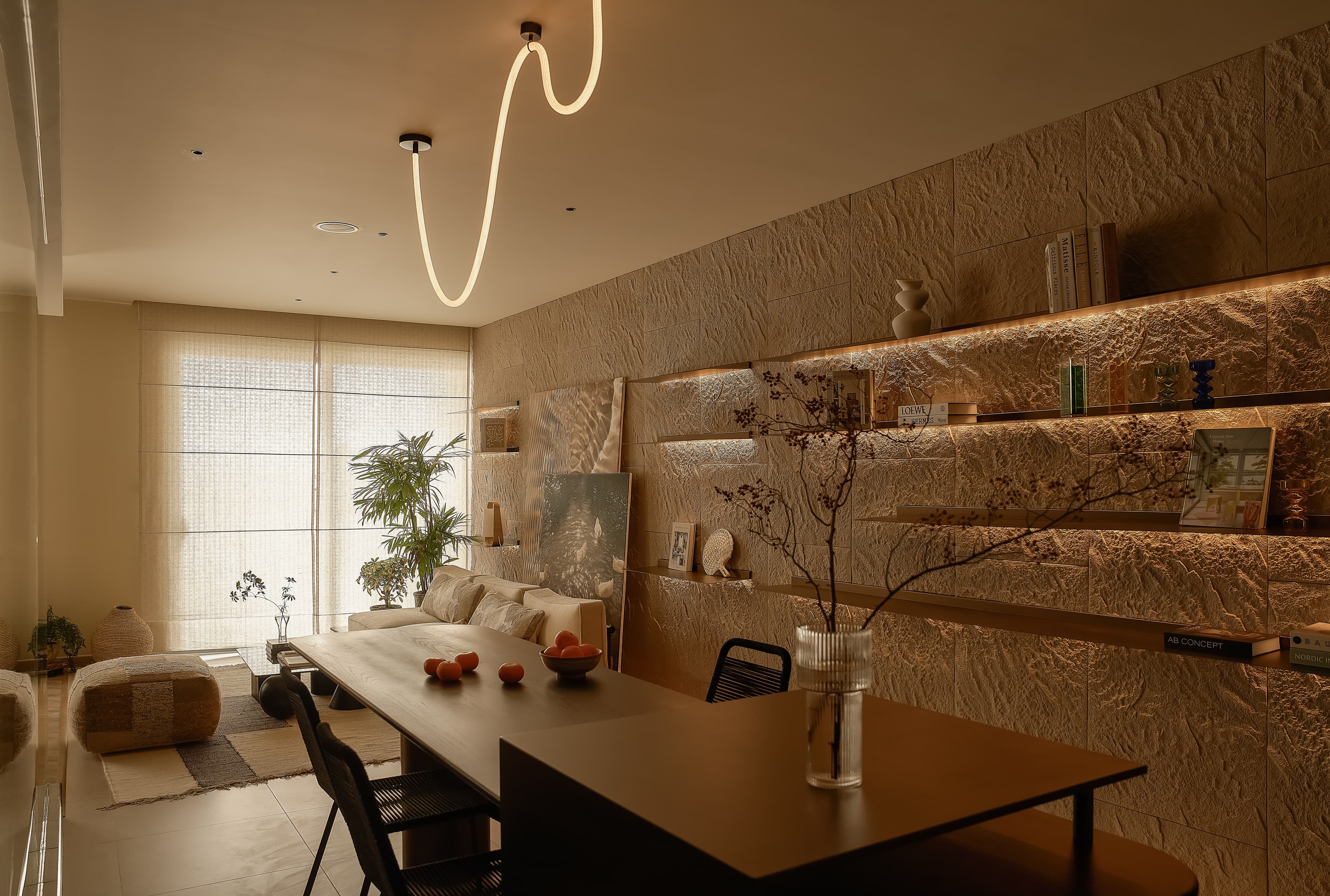
At SoulRoom, we design and build homes that are beautiful, comfortable and suited to your budget. In Tom House, a textured feature wall with built-in lit shelving gives the living and dining space its character, so a few well-chosen pieces of furniture are enough.
If you are about to renovate an older apartment, send us a message with photos of each room, and we will help you decide what to keep, what to fix and where your budget will make the biggest difference.